_edited.png)
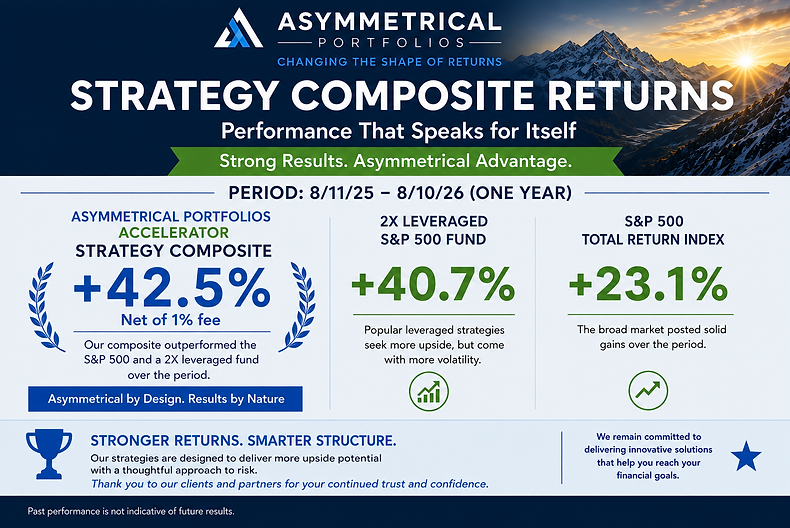
Our Track Record
Disclosures
Important Disclosures:
1. Composite performance represents the asset-weighted aggregate performance of the relevant positions in all client accounts implementing the strategy during the period presented and is presented net of a model advisory fee equal to AP/Aurora Private Wealth's highest fee for this strategy (1.00% annually). The fee was prorated for the applicable measurement period and deducted on a quarterly basis consistent with our standard billing practices. There are no other accounts that implement the strategy that are not represented in the composite performance. The returns of these positions may not be representative of all other positions in the account.
2. The primary investment performance gains of this strategy have been generated by increases in the value of the call options. Calls should be considered a “leveraged” investment, and an investor can lose 100% of the amount paid for the option.
3. Income in the strategy is currently generated through investment in the Calamos Autocallable Income ETF (Ticker: CAIE). Proceeds were either re-invested into CAIE or maintained in cash. Returns include the income from CAIE.
4. The strategy inception date is August 11, 2025. The strategy has been in existence for only one year. Short periods of time may not be representative of future or long-term results.
5. The Ultra S&P 500 ETF (SSO) is a publicly available exchange-traded fund that seeks daily investment results that correspond, before fees and expenses, to 2x the daily performance (both to the upside and the downside) of its underlying benchmark— the S&P 500® Index. It invests principally in equity securities and derivatives (e.g. swap agreements and futures contracts) in order to gain leveraged exposure to the index.
6. The S&P 500 Total Return Index is an unmanaged index that reflects the reinvestment of dividends and is presented solely for comparative purposes. Investors cannot invest directly in an index. The strategy uses options and may employ leverage through long call options. As a result, the strategy's risk profile, volatility, and return characteristics differ materially from those of the S&P 500 Total Return Index, and the index is not intended to represent a directly comparable investment.
7. Before trading options, investors should review Characteristics and Risks of Standardized Options.
Because equity markets were generally positive during the period presented, these results provide limited information regarding how the strategy may perform in a declining market environment.
Past performance is not indicative of future results. The information provided herein is for informational purposes only and does not constitute an offer to sell or a solicitation of an offer to buy any securities. Investing involves risk, including the possible loss of principal. Past performance does not guarantee future results. Any projections, forecasts, or forward-looking statements are based on assumptions and subject to significant uncertainties and contingencies, many of which are beyond our control. Actual results may differ materially from those anticipated. This material is not intended to be relied upon as investment advice or recommendations, does not constitute a solicitation to buy or sell securities, and is not provided in a fiduciary capacity. Please consult your own legal, tax, and financial advisors before making any investment decisions.
Program Description
Asymmetrical Positions are combinations of publicly traded securities selected with the objective of achieving, as a whole, a combination of fixed income return and long-term growth while also protecting against market volatility. Securities included in Asymmetrical Positions normally include auto-callable note funds and call options and / or put options, depending on the strategy and market conditions. The Asymmetrical Position is valued on its performance as a whole, which means some securities in the Position may decrease in value or, in the case of options, even expire without value in order to achieve the intended return on the Position as a whole.
Program Risks
Asymmetrical Positions involve several securities and assume various risks, including the risk of loss. While the intention of the Position is to achieve overall positive returns and long-term growth, there is no guarantee that those goals will be met in each instance. Market conditions and events outside the control of APW can impact the success of the Position. A structured position consists of a combination of financial instruments, such as bonds, bond funds, autocallable note funds, call options and put options that are intentionally diversified across product types (“Position”). The Position’s performance is viewed based upon the overall performance of all product types and holdings within the Position. Individual Position parts may gain or lose value over time and the Position may continue to hold investments that have decreased in value. All investments involve risk of loss of principal. An investor must be willing and able to assume such losses. Although the Position’s objective is to generate fixed income returns and long term growth, there is no guarantee that the Position will be successful or generate those results. There is no assurance the Position will perform as expected or anticipated. Derivative income positions can “disconnect”, or move either in opposition to, or to a degree lesser or greater than, market indices, and the investor assumes this risk. Derivative income positions under certain market conditions may also not produce the full yield initially expected. Finally, derivative income positions are subject to risk of default, either as to yield or principal, under certain conditions, and the investor assumes this risk. These risks can cause losses to be greater, or gains to be lower, than expected. Any and all projections of potential returns or market downside protection assume the final position at expiration, and prior to expiration of any position there will be more volatility, and risk of interim loss in value, than at expiration. Any illustrations, graphs or charts presented to the investor are for illustrative purposes only, and actual returns will likely be higher or lower than those projected.
Asymmetrical Positions are a selected mix of securities designed to work in parallel to generate income and long-term growth, while protecting against market downside. Therefore, Asymmetrical Positions include a limited number of products that function, in tandem, to achieve this objective. Other income generating products exist, like stocks and bonds and funds, but those products are usually not included in an Asymmetrical Position. While intended to protect against market downside, Asymmetrical Positions are still market-traded products and remain subject to market volatility. The investor may experience fluctuations in price, decreases in value, and losses inherent in any investment in the market. The investor assumes any losses in the fixed income that occur, whether or not the investor has chosen to accept less market upside by purchasing puts on the underlying index or position. Investment performance is not guaranteed. You should not assume that investment decisions made in the future will be profitable or will equal the investment performance of the past. Asymmetrical Positions that use options are a more complex strategy than buying equities and mutual funds from an exchange. These investment strategies also involve certain risks. Options are not suitable for all investors. There are risks involved in any option strategy. Individuals should not enter into option transactions until they have read and understood the option disclosure document titled "Characteristics and Risks of Standardized Options," which outlines the purposes and risks of option transactions. The information provided should not be considered a recommendation to purchase or sell a particular security and/or other investments or investment strategies. Returns are shown net of management fees, trading costs, and other direct expenses. The investor should independently evaluate all relevant factors prior to making any investment.
Investment advice offered through Aurora Private Wealth, Inc. an SEC-registered advisor.
Securities offered through APW Capital, Inc. Member FINRA/SIPC/MSRB
999 Riverview Dr. Suite 201 Totowa, NJ 07512 | 973-394-0404